Duckuments logo
send sensitive documents securely

How to Send Sensitive Documents Securely Without Slowing Everyone Down

You have a sensitive document to send right now and need a safer option than attaching it to an email.

  • Use a secure link instead of an attachment.
  • Set expiry and access controls before sharing.
  • Check document sensitivity before choosing safeguards.
Send Sensitive Documents Securely with Duckuments

Buyer problem

Anyone sending files that contain personal, financial, legal, medical, employee, or confidential business information.

The quick answer: do not send the file as a plain attachment

If a document contains personal data, bank details, contracts, identity documents, payroll information, legal content, or confidential business material, an ordinary attachment gives you very little control after sending.

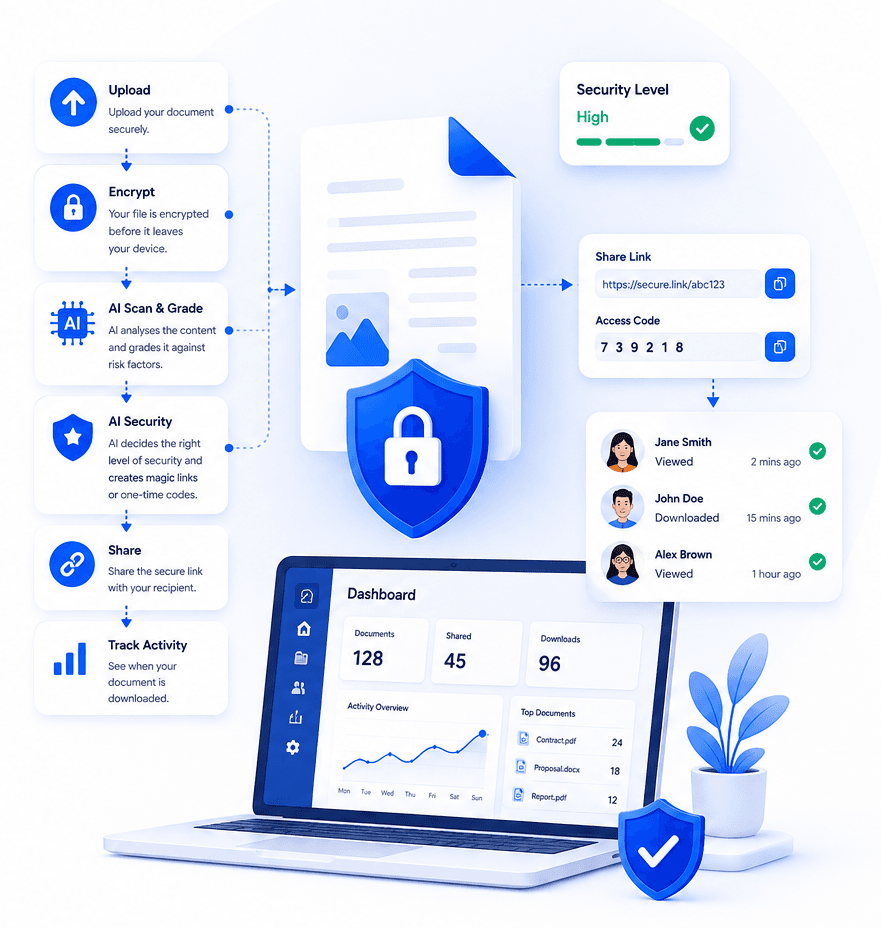
A safer workflow is to upload the document to a secure platform, assess the risk, create a protected link, verify the recipient where needed, and set expiry or download limits.

Use stronger controls when the content is more sensitive

Not every document needs the same handling. A brochure is different from a passport scan. A routine agenda is different from a redundancy letter. Duckuments helps identify document risk and apply protection that matches the contents.

That keeps the process fast for ordinary documents and more deliberate for files that could cause harm if exposed.

How Duckuments helps

Duckuments gives you a secure sending path in the moment you need it.

Upload and assess

Check sensitivity before choosing how to share.

Share a protected link

Avoid permanent uncontrolled copies in email threads.

Track access

Know whether the recipient opened or downloaded the file.

Put risk-aware sharing into practice

Upload a document, assess its sensitivity and share it with controls that fit the risk.

Start free

Frequently asked questions

What is the safest way to send sensitive documents?

Use a secure sharing platform with encryption, controlled links, expiry, recipient verification where needed, and access tracking.

Which documents count as sensitive?

Documents containing personal data, identity details, financial information, legal material, health information, employment records, or confidential business information should be treated as sensitive.

Related guides

Explore secure document workflows

Duckuments overview

Secure document sharing

Share confidential documents with controlled links, encryption, expiry rules, recipient verification, and audit-ready visibility.

Encrypted file sharing

Send encrypted files through secure links with recipient-friendly access, expiry controls, and visibility into document activity.

Document risk assessment

Use AI-powered document risk assessment to identify sensitive content and apply the right protection before sharing.

Client document portal

Give clients a secure way to send and receive sensitive documents without relying on risky inbox attachments.

AI document security

Use AI document security to detect sensitive content, assess risk, and apply practical safeguards before documents are shared.

For accountants

Help accounting firms send and receive tax records, statements, payroll files, and client documents through secure controlled links.

For law firms

Share legal documents, evidence, contracts, and client files with controlled access, expiry, tracking, and AI-powered risk assessment.

For HR

Send and receive HR documents such as contracts, right-to-work evidence, payroll files, medical notes, and employee records securely.

GDPR document sharing

Practical guidance for GDPR-conscious document sharing with secure links, access controls, expiry, audit logs and AI risk assessment.

Client document sharing

Share client documents through secure links with recipient checks, expiry, activity visibility and AI-powered document risk assessment.

AI risk assessment

Assess document sensitivity with AI before sharing. Identify personal, financial, legal and confidential risk signals, then apply protection.

AI classification

Classify documents by sensitivity and risk with AI-assisted analysis, from personal data and financial details to confidential business content.

Security

See how Duckuments protects sensitive documents with encryption, secure links, recipient checks, expiry controls, audit logs, and AI-supported risk assessment.

Encryption

Learn how Duckuments uses encryption as part of a broader secure document sharing workflow with controlled links, expiry, and recipient checks.

Audit logs

Duckuments records document activity so teams can see uploads, sharing decisions, recipient access, downloads, and security-relevant events.

Data handling

Understand how Duckuments approaches sensitive document handling with secure upload, encrypted storage, controlled sharing, expiry, and deletion workflows.

AI usage/privacy

Duckuments uses AI to help assess document sensitivity while keeping the purpose practical: safer sharing decisions and appropriate safeguards.

GDPR file sharing

Share sensitive files through GDPR-conscious workflows with encryption, secure links, access controls, expiry, audit logs and AI risk assessment.

FAQs

Answers to common questions about Duckuments security, encryption, audit logs, AI document risk assessment, data handling, and compliance posture.

Start with one document

Share sensitive documents with more control

Duckuments helps you assess document risk, apply appropriate safeguards and keep visibility after sharing.

Send a sensitive document securely