Duckuments logo
AI document risk assessment

AI Document Risk Assessment Before Secure Sharing

The sender may not know whether a document contains hidden personal, financial, legal or confidential information until it has already been shared.

  • Analyse content for sensitivity signals before sharing.
  • Turn risk factors into a practical risk grade and recommended protection.
  • Use stronger controls for documents with higher exposure risk.
AI Document Risk Assessment with Duckuments

Buyer problem

Teams that want to classify document risk before sending sensitive files to clients, employees or external organisations.

Document risk assessment turns content into a decision

Document risk assessment is the process of reviewing a file before it is shared and deciding what protection is appropriate. The risk comes from both the content and the context: who is receiving it, why they need it and what would happen if the wrong person accessed it.

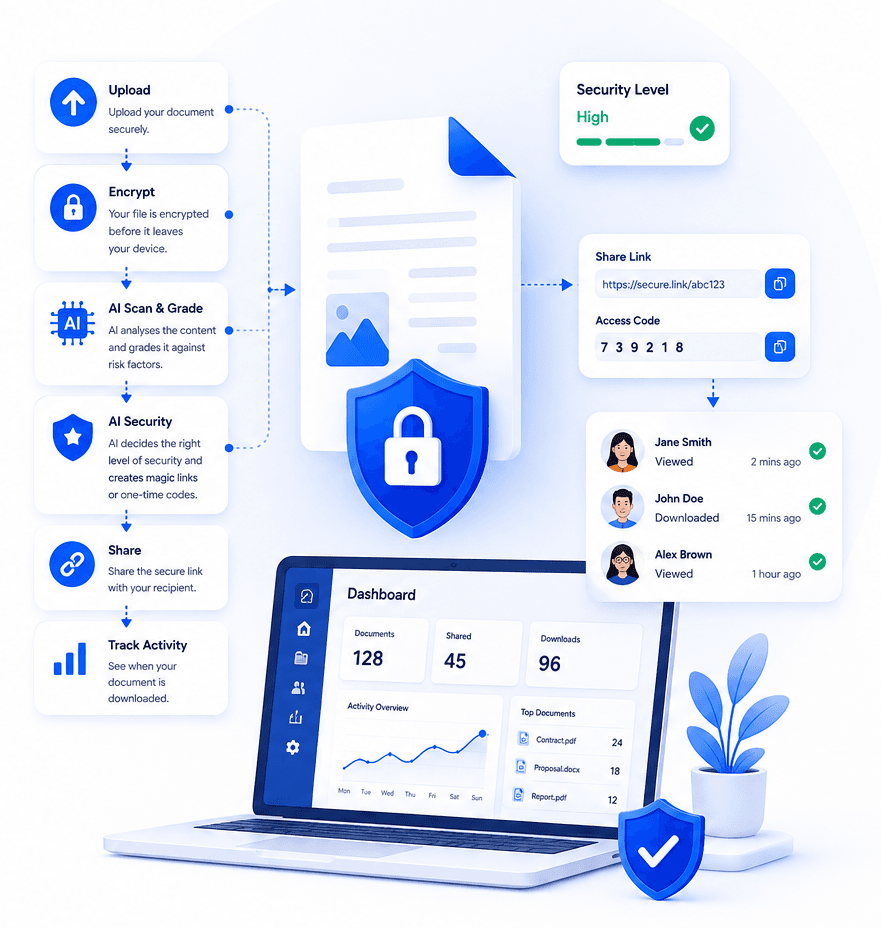
Duckuments is built around the workflow: document, AI analysis, risk factors, risk grade, recommended security, secure sharing.

Manual classification is easy to get wrong

A sender may remember that a file is a contract, but miss that it also contains personal contact details, signatures, bank information, commercial terms or employment context. Time pressure makes those misses more likely.

AI can support the sender by reviewing the document for signals such as personal information, financial details, identity references, legal content, employee data and confidential business information.

Risk assessment should change the sharing controls

A risk score is useful only when it affects what happens next. Lower-risk files can move through a lighter secure link flow. Higher-risk files may need shorter expiry, recipient verification, download limits and closer auditability.

Duckuments helps connect analysis to action so teams can protect sensitive documents before they leave the sender's control.

How Duckuments helps

Duckuments turns AI analysis into proportionate document protection.

Sensitivity analysis

Identify personal, financial, legal and confidential content before sharing.

Risk grading

Separate routine documents from files that deserve stronger safeguards.

Recommended security

Use the assessment to guide expiry, OTP checks and secure sharing settings.

Put risk-aware sharing into practice

Upload a document, assess its sensitivity and share it with controls that fit the risk.

Start free

Frequently asked questions

What is AI document risk assessment?

It is AI-assisted review of a document's contents and sensitivity signals to help decide what security controls should be used before sharing.

Does AI replace human judgement?

No. AI supports faster and more consistent triage, but organisations remain responsible for their policies, legal obligations and final sharing decisions.

Related guides

Explore secure document workflows

Duckuments overview

Secure document sharing

Share confidential documents with controlled links, encryption, expiry rules, recipient verification, and audit-ready visibility.

Encrypted file sharing

Send encrypted files through secure links with recipient-friendly access, expiry controls, and visibility into document activity.

Document risk assessment

Use AI-powered document risk assessment to identify sensitive content and apply the right protection before sharing.

Client document portal

Give clients a secure way to send and receive sensitive documents without relying on risky inbox attachments.

AI document security

Use AI document security to detect sensitive content, assess risk, and apply practical safeguards before documents are shared.

For accountants

Help accounting firms send and receive tax records, statements, payroll files, and client documents through secure controlled links.

For law firms

Share legal documents, evidence, contracts, and client files with controlled access, expiry, tracking, and AI-powered risk assessment.

For HR

Send and receive HR documents such as contracts, right-to-work evidence, payroll files, medical notes, and employee records securely.

Send sensitive documents

Learn how to send sensitive documents securely with encrypted links, expiry, recipient checks, activity tracking, and AI-powered risk assessment.

GDPR document sharing

Practical guidance for GDPR-conscious document sharing with secure links, access controls, expiry, audit logs and AI risk assessment.

Client document sharing

Share client documents through secure links with recipient checks, expiry, activity visibility and AI-powered document risk assessment.

AI classification

Classify documents by sensitivity and risk with AI-assisted analysis, from personal data and financial details to confidential business content.

Security

See how Duckuments protects sensitive documents with encryption, secure links, recipient checks, expiry controls, audit logs, and AI-supported risk assessment.

Encryption

Learn how Duckuments uses encryption as part of a broader secure document sharing workflow with controlled links, expiry, and recipient checks.

Audit logs

Duckuments records document activity so teams can see uploads, sharing decisions, recipient access, downloads, and security-relevant events.

Data handling

Understand how Duckuments approaches sensitive document handling with secure upload, encrypted storage, controlled sharing, expiry, and deletion workflows.

AI usage/privacy

Duckuments uses AI to help assess document sensitivity while keeping the purpose practical: safer sharing decisions and appropriate safeguards.

GDPR file sharing

Share sensitive files through GDPR-conscious workflows with encryption, secure links, access controls, expiry, audit logs and AI risk assessment.

FAQs

Answers to common questions about Duckuments security, encryption, audit logs, AI document risk assessment, data handling, and compliance posture.

Start with one document

Share sensitive documents with more control

Duckuments helps you assess document risk, apply appropriate safeguards and keep visibility after sharing.

Try AI-powered document risk assessment